In letzter Zeit werden immer wieder einige neue Begriffe verwendet, so zum Beispiel „virtual reality“, „augmented reality“ und „mixed reality“.
Was hat man sich darunter vorzustellen?
Unter einer „virtual reality“ kann man sich ja noch einiges vorstellen.
Im althergebrachten Fall ist es eine „virtual reality“, wenn ich ein Buch lese. Durch das Lesen „versetze“ ich mich selbst in eine „andere“ Wirklichkeit, in eine Wirklichkeit, die nicht „wirklich“ existiert, sondern nur „virtuell“.
Das heisst nicht, dass diese Wirklichkeit unschärfer sein muss.
Über die Gedankengänge eines James T. Kirk, der nur virtuell existiert, ist mehr bekannt, als über die Gedankengänge von Napoleon, der real existiert hat.
Die heutige Computertechnik ermöglicht es uns, virtuelle Welten zu erstellen, die es möglich machen, sich in diese Welt zu versetzen, ohne allzu viel Phantasie aufwenden zu müssen, da die Simulationen schon sehr realitätsnah sind. Wir sprechen von photorealistischer 3D-Graphik.
Der Begriff der „augmented reality“ ist eindeutig im militärischen Bereich entstanden. Denken wir nur an ein HUD (heads up display), welches einem Piloten in einem Kampfflugzeug diverse Informationen in sein Sichtfeld einblendet, die es ihm ermöglichen, das Gesehene und Gehörte besser und einfacher zu interpretieren.
Bei der „augmented reality“ lebe ich also nach wie vor in der „echten“ Realität, die Computertechnik „verbessert“ diese Realität aber dahingehend, dass ich Dinge wahrnehmen kann, die ich ohne Computertechnik nicht wahrnehmen könnte.
Mit der „mixed reality“ hatte ich immer schon Verständnisschwierigkeiten. Ich konnte mir darunter nichts genaues vorstellen.
Dann kam ich dahinter: mit „mixed reality“ kann man verschiedene Dinge meinen. Einerseits ist der Übergang von „augmented reality“ zu „mixed reality“ ein fließender. Denn die „augmented reality“ hilft mir, reale „Entitäten“ besser zu erkennen, während die „mixed reality“ neue, virtuelle, Entitäten sozusagen „zur Wirklichkeit hinzufügen kann“.
Andererseits kann mit „mixed reality“ gemeint sein, dass man zwei oder mehr „Wirklichkeiten“ gleichzeitig „bewohnt“.
All das habe ich versucht, in der „Beschreibung des konzeptionellen Protokolls C3P (Collaborative 3D Profile)“ zu berücksichtigen.
1. Modes of Operation of C3P
Personal scene instances are inhabited by users.
Each user can inhabit more than one personal scene instance and he can additionally inhabit the reality.
The scene instances synchronize each other via the connectivity platform.
C3P connects the connectivity platform with the scene instances, in a star environment.
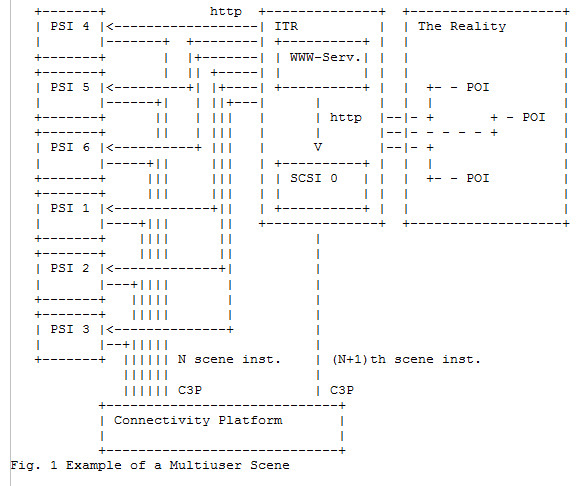
Legend:
PSI……..Personal Scene Instance
SCSI…….Server/Controller Scene Instance
ITR……..Interface To Reality
POI……..Point of Interest/Point of Interaction
C3P……..Collaborative 3D Profile
1.1. Virtual/Augmented Reality
1.1.1. Singleuser VR Mode (w/wo interception of trajectory)
In SVR mode, a multiuser session consists of one and only one personal scene instance, which may have been downloaded from a WWW server.
The scene instance virtually represents an interactive, animated scene, which may be a snapshot representation of a subset of the reality.
If the user is not restricted to a pure virtual environment (e.g. some holo-deck like installation), i.e. if the user inhabits reality, then the scene instance may augment this reality.
1.1.2. Multiuser VR Mode (w/wo interception of trajectories)
In MVR mode, a multiuser session consists of several or many personal scene instances, allowing the users to virtually collaborate in a virtual scene, which may have been downloaded from a WWW server.
The scene instances virtually represent an interactive, animated scene, which may be a snapshot representation of a subset of the reality.
The users are able to communicate with each other, using e.g. chat, voice chat, avatar gestures etc.
If the users are not restricted to pure virtual environments (e.g. some holo-deck like installations), i.e. if the users inhabit reality, then the scene instances may augment these realities.
1.2. Mixed Reality Mode (w/wo interception of trajectories)
In MR mode, a multiuser session consists of one, several or many personal scene instances and a server/controller scene instance, allowing the users to collaborate in a scene, which has been downloaded from the WWW server.
The personal scene instances virtually represent an interactive, animated scene, which is a representation of a subset of the reality.
The server/controller scene instance connects the multiuser session with the reality via points of interest/points of interaction. It must be clear that the subset of the reality and the representations of the subset of the reality in the scene instances might not be 100% aligned. This is due to the fact that not everything (every state, every shape, every collateral entity of the subset of the reality, etc.) can be modeled in the representation 100% correctly, nor can it be kept synchronous with the reality in a 100% correct manner.
Hence the reality will often be equalized with a model of the reality. The model of the reality is downloaded via http from the WWW server.
Points of Interaction are entities, that allow bi-directional data exchange between personal scene instances and the reality.
Points of Interest are entities, that allow uni-directional data exchange from the reality to personal scene instances.
The users are able to communicate with each other, using e.g. chat, voice chat, gestures etc.
If the users are not restricted to pure virtual environments (e.g. some holo-deck like installations), i.e. if the users inhabit reality, then the scene instances may augment these realities.
Users, who inhabit reality, may influence the reality directly and hence indirectly impact the representation of the reality within the scene.
1.3. Operating Modes of POIs and Views of Users
Each user may have a different view to the scene. It’s even possible, that a user has more than one view to the scene (this may e.g. happen, when he inhabits more than one personal scene instance).
- 3rd person view – such a user will not have the possibility to influence the scene, but he can be connected to the sensors of a POI
- pilot view – such a user has the possibility to influence the reality via a POI (he is the pilot of the POI)
- real view – the user inhabits the subset of the reality and can interact with the scene without the help of the CP
Each POI operates in one of the following operating modes at a given time
- AC/DC Modes
- Autonomous Mode/Connected
the POI may be connected to a pilot, but his influence to the POI is limited
the sensors of the POI can additionally be connected to 3rd person views - Disconnected Mode
the POI is not connected to the ITR
- Autonomous Mode/Connected
- Connected Mode
the POI is controlled by a pilot *)
the sensors of the POI can additionally be connected to 3rd person views
*) the connection between POI and pilot should be designed in a way, so that a possible outage of the ITR does not influence the controllability of the POI.


 Veröffentlicht von Yeti

 Christophs Blog